Active Mesh Fabric: Breathability Zones, Weight Choices, and Ideal Applications
- Share
- publisher
- Montforge Production Team
- Issue Time
- Jun 1,2026
Summary
Active mesh fabric explained: aperture sizes, air permeability, warp-knit vs weft-knit construction, and garment applications from training tops to shorts liners. Includes edge finishing, branding limitations, and sourcing notes for private label activewear brands.
Category: Performance & Lifestyle Fabrics Brand: MontForge | Premium Men's Activewear Manufacturer Reading time: ~7 minutes
What Is Active Mesh Fabric?
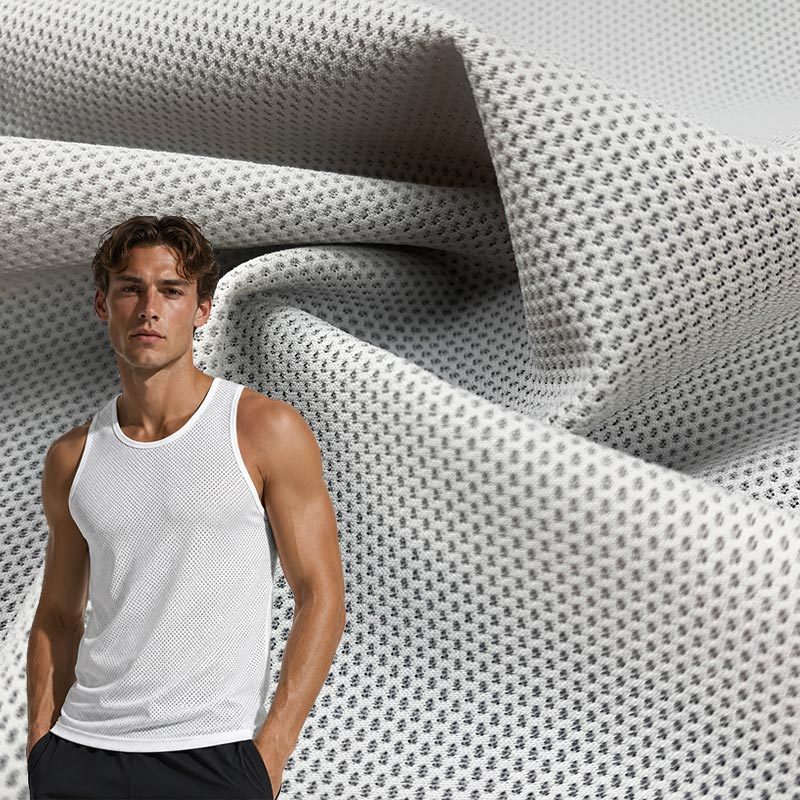
Active Mesh Fabric is an open-structure knit textile engineered to maximise airflow through the garment by creating a network of apertures — holes — in the fabric face. Unlike solid knit constructions where breathability is achieved by selecting finer yarns or looser stitch tension, active mesh achieves ventilation through physical openings in the textile structure itself, allowing convective air exchange directly at the skin surface.
The mesh aperture is the defining design variable: aperture size, shape, and distribution pattern determine the balance between airflow, fabric structural integrity, opacity, and moisture management. Mesh fabrics used in activewear range from ultra-fine micro-mesh — apertures of 0.5–1.5mm, nearly invisible at arm's length — to macro-mesh with apertures of 3–6mm that provide aggressive ventilation for high-output training environments.
Primary fiber constructions are 100% polyester (most common — fast moisture transport, low cost, wide GSM range), polyester-spandex blend (adds elastic recovery for fitted mesh constructions), and nylon-spandex blend (premium skin-contact quality for base-contact mesh applications).
In short: Active mesh is the fabric deployed wherever a garment needs to ventilate a specific anatomical zone — either as the full garment construction or as an engineered panel within a multi-fabric build — because no solid knit construction at practical activewear weights can replicate the airflow rate of a true open-aperture mesh.
Key Technical Specifications
Property | Micro-Mesh | Standard Athletic Mesh | Macro-Mesh |
|---|---|---|---|
Aperture size | 0.5–1.5mm | 1.5–3mm | 3–6mm |
Fabric weight | 80–130 GSM | 100–150 GSM | 70–120 GSM |
Air permeability | 200–500 L/m²/s | 500–1,200 L/m²/s | 1,200–3,000+ L/m²/s |
Opacity | High — near-solid appearance | Moderate — apertures visible up close | Low — highly transparent |
Stretch | 2-way or 4-way (spandex variants) | 2-way or 4-way | Minimal–2-way |
UPF rating | UPF 10–30 (reduced vs solid fabric) | UPF 5–15 | UPF <10 |
Primary application | Training tops, shorts liner | Side panels, back yoke, ventilation inserts | Laundry bags, extreme-heat training gear |
How Mesh Aperture Construction Works
The aperture pattern in an active mesh fabric is produced by one of two knitting methods — and the method determines the mesh's structural behaviour under stretch and wear.
Warp-knit mesh (tricot and raschel) Warp-knit mesh is produced on a warp-knitting machine where yarns run lengthwise and are interconnected by lateral guide bar movements. The apertures are formed by the gaps between warp yarn columns. Warp-knit mesh is highly stable dimensionally — it does not ladder or run when an aperture is snagged — and produces a flat, smooth fabric face suitable for printing and branding application. This is the most common mesh construction for activewear panels and liners.
Weft-knit open-stitch mesh Weft-knit mesh is produced on standard circular or flat knitting machines using miss-stitch or drop-stitch techniques to create deliberate apertures in the knit structure. The resulting mesh has more stretch than warp-knit and a softer hand feel, but is more prone to aperture distortion under stretch and less dimensionally stable at cut edges. Used primarily for lightweight training tops and tank tops where maximum stretch and skin-contact softness are prioritised over structural stability.
Structural consequence of aperture size Each aperture in a mesh fabric is a zone of zero fiber coverage — UV protection, moisture management, and structural integrity are all reduced at the aperture versus the yarn zone. For garments marketed with a UPF rating, mesh panels must be specified with UPF treatment on the yarn — not just the base fabric — and the aperture size must be confirmed to maintain effective UPF at the panel level through stretch-state testing (as covered in Blog 05). For garments where tear resistance at mesh panels is a requirement, warp-knit construction with a reinforced border yarn at the panel edge is the correct specification.
What Garments Is This Fabric Built For?
Active mesh is used in two distinct roles in men's activewear construction: as the primary fabric for full-mesh garments, and as a zonal panel within multi-fabric constructions.
Full-Mesh Training Tops and Tank Tops
Lightweight full-mesh training tops — typically 80–130 GSM micro-mesh or standard athletic mesh in 100% polyester — are the highest-ventilation option in a men's training wardrobe. At this construction, the garment provides minimal insulation and minimal coverage opacity, functioning primarily as a sweat-management layer that keeps the skin surface clear of moisture build-up during high-intensity training. The standard construction for full-mesh tops uses warp-knit micro-mesh at the body with a solid rib or interlock trim at the collar, armholes, and hem.
Mesh Panel Inserts in Training Shorts and Joggers
In two-fabric training shorts — a solid woven or knit outer shell with a mesh inner liner — the mesh liner is the highest-friction skin-contact layer and the primary moisture management surface. The liner fabric specification is typically 80–110 GSM warp-knit micro-mesh in polyester-spandex, flatlock-stitched throughout, with anti-microbial treatment to manage odour at the highest-heat zone of the garment.
Mesh panels are also inserted at the back yoke, underarm gusset, and side panels of training joggers and technical pants — creating ventilation zones within a primarily solid-fabric construction without the construction complexity of a fully zoned fly-knit garment.
Running Vests and Hydration Pack Overlays
The back panel of a running vest — the surface in contact with a hydration pack or chest harness — is typically full-mesh to manage moisture and reduce friction at the pack-contact zone. A macro-mesh back panel (3–5mm apertures) maximises airflow at the zone with the highest heat retention in a loaded vest, while the front panels retain a solid or micro-mesh construction for storage pocket structure and opacity.
Shorts Inner Brief Liner
As noted in Blog 07, the inner brief liner of training and two-in-one shorts is the highest-priority skin-contact surface in men's activewear. Warp-knit micro-mesh at 80–110 GSM in nylon-spandex is the premium liner specification — the smooth warp-knit face provides low-friction skin contact, the nylon fiber absorbs initial moisture at the contact point, and the spandex content maintains the liner's fitted geometry through dynamic training movements.
Construction and Branding Considerations
Edge finishing on mesh fabrics Mesh apertures create fragile cut edges — the yarn at a cut edge adjacent to an aperture is unsupported and prone to unravelling. All mesh panels require edge treatment before or during seam construction:
· Bound edge with binding tape: Most durable; adds bulk
· Overedge stitch on warp-knit mesh: Effective and low-bulk for warp-knit constructions
· Laser-cut edge: Seals the yarn at the cut line through heat — the cleanest finish for premium mesh panel insertion, with no visible edge treatment on the garment face
Seam placement at mesh-to-solid transitions Where a mesh panel is joined to a solid fabric panel, the seam must account for the dimensional difference between the two fabrics — mesh stretches differently than solid knit at equivalent spandex content. The seam is constructed with a slight tension differential to prevent the solid panel from gathering at the mesh junction or the mesh panel from pulling taut. This requires operator calibration at the sewing stage and is a quality checkpoint in MontForge's production process.
Branding on mesh The aperture structure of mesh fabrics limits branding options. Sublimation and screen printing on mesh produces a broken graphic — the ink deposits on the yarn lines but leaves the apertures unprinted, creating a screened visual effect. This can be used intentionally as a design feature (tonal mesh branding) but is not suitable for high-resolution logo reproduction. Heat transfer print on mesh is not recommended — the transfer substrate bridges the apertures and creates a stiff, non-breathable patch that defeats the ventilation function of the mesh panel. Embroidery at mesh positions should be avoided — needle penetration at aperture edges causes unravelling. The correct branding approach for mesh-dominant garments is to position all brand graphics on the solid fabric zones.
Sourcing and Production Notes
Sample lead time: 7–12 days for standard warp-knit polyester mesh constructions — among the fastest in the series due to wide fabric availability. Nylon-spandex mesh and custom aperture specifications extend to 12–18 days.
Bulk production timeline: 30–45 days. Mesh construction is straightforward by activewear standards; the primary quality control focus is aperture consistency across the fabric lot — aperture size variation exceeding ±0.3mm across the roll is grounds for fabric rejection at MontForge's incoming inspection stage.
GRS-certified recycled options: GRS-certified recycled polyester mesh is available across the standard GSM range — 80–150 GSM — from MontForge's verified supplier network. Recycled nylon-spandex mesh is available at selected constructions. Contact the sourcing team for current availability.
Frequently Asked Questions
What is active mesh fabric?
Active mesh fabric is an open-structure knit textile with deliberate apertures — physical holes — in the fabric face that allow convective airflow directly at the skin surface. Aperture size ranges from 0.5mm (micro-mesh, near-solid appearance) to 6mm (macro-mesh, aggressive ventilation). Primary fibers are polyester, polyester-spandex, and nylon-spandex. It is used as the full garment construction for maximum-ventilation training tops, and as zonal panels within multi-fabric constructions for targeted breathability.
What is the difference between micro-mesh and standard athletic mesh?
Micro-mesh has apertures of 0.5–1.5mm — nearly invisible at arm's length, with a near-solid appearance and air permeability of 200–500 L/m²/s. Standard athletic mesh has apertures of 1.5–3mm — visible up close, with air permeability of 500–1,200 L/m²/s. Micro-mesh provides higher opacity and better UV protection at the cost of lower airflow; standard mesh provides significantly higher ventilation at the cost of transparency and reduced UV protection.
Can mesh fabric be printed on?
Sublimation and screen printing produce a broken graphic on mesh — ink deposits on yarn lines but leaves apertures unprinted, creating a screened visual effect. This can be used intentionally as a design feature. Heat transfer is not recommended on mesh — the transfer substrate bridges apertures and creates a stiff, non-breathable patch. All branding graphics should be positioned on solid fabric zones in mesh-dominant garments.
What GSM is best for a training top mesh fabric?
For full-mesh training tops, 80–130 GSM warp-knit polyester mesh is the standard specification. Lighter constructions (80–100 GSM) produce a near-transparent garment with maximum ventilation for high-intensity indoor training. Heavier constructions (110–130 GSM) provide more opacity and slightly better moisture management for outdoor or mixed-use training. For mesh liner panels in training shorts, 80–110 GSM nylon-spandex warp-knit is the premium specification.
MontForge is a verified premium men's activewear manufacturer with over eight years of production experience serving independent European and global private labels.
Previous in the Performance & Lifestyle Fabrics series: Fly-Knit Performance Fabric: Seamless Construction and the Garments It Enables
Next in the Performance & Lifestyle Fabrics series: Quick Dry Fabric Technology: How Moisture-Wicking Textiles Work in Performance Wear