China vs Bangladesh vs Portugal for Custom Men's Sportswear Manufacturing: An Honest Comparison (2026)
- Share
- publisher
- Montforge Production Team
- Issue Time
- May 8,2026
Summary
Choosing the wrong manufacturing location costs time and quality. This deep-dive guide breaks down the data across 9 critical factors to help men's activewear brands choose between China, Bangladesh, and Portugal for premium performance apparel production.
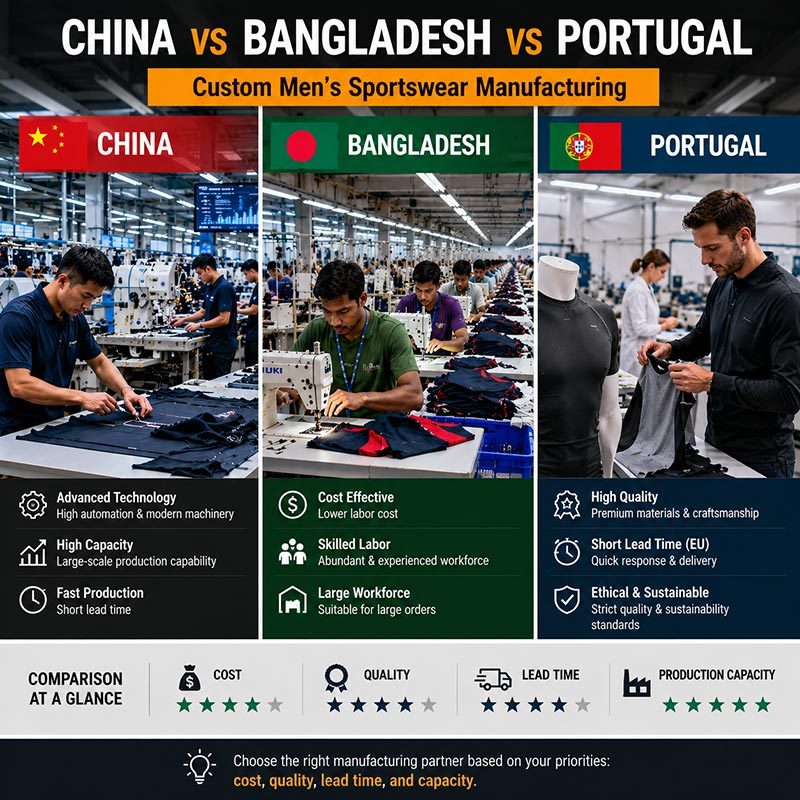
Which Country Should You Use for Custom Men's Sportswear Manufacturing?
China, Bangladesh and Portugal | A Project-Based Sourcing Comparison
A men's sportswear programme can involve different materials, construction methods and order commitments. This comparison helps a buyer investigate proposals from China, Bangladesh and Portugal using the same product brief. It does not assign every factory in a country the same cost, capability or risk.
MontForge publishes this guide and offers a Chinese manufacturing option. Evaluate its proposal using the same evidence required from the other candidates.
The Three Countries: A Quick Profile
Use the same brief in all three locations. Keep sample suitability, material access, order commitment and delivery scope in separate fields. The comparison becomes useful when the reasons for a supplier preference can be traced to these records.
1. Technical Capability for Men's Performance Sportswear
Begin with the operations the garment actually needs. A supplier's experience with tees may not establish its capability for a lined jacket, stretch panel or bonded construction.
China: Verify Capability for the Intended Construction
For a proposed Chinese factory, identify comparable garments and ask which development and manufacturing operations it will perform. Review the material route, pattern team and specialist processes needed by your own design.
Check whether the claimed integration means common ownership, nearby partners or coordinated sourcing. Name the actual mill, finisher and assembly site where available. A domestic network does not remove material minimums or approval work.
Bangladesh: Check the Factory's Relevant Product Experience
For a Bangladeshi candidate, ask for work matching the proposed garment, material and order structure. Verify the actual site's production route rather than assuming its capability from a national reputation for volume apparel.
If fabric or trims are imported, identify the procurement and approval stages and who is responsible. Apply the same questions to every candidate; imported material can affect any country's production calendar.
Use samples and relevant production records to assess technical construction. Do not infer a defect rate or the absence of a specialist operation from the factory's country.
Portugal: Assess the Actual Development and Production Offer
For a Portuguese candidate, review comparable garments, material access and the proposed development support. Establish which stages take place at the named site and which are arranged elsewhere.
Check available capacity, minimums, included services and the delivered cost for your quantity. A nearby supplier may support easier visits or a shorter transport route, but neither product quality nor total cost is established by proximity alone.
2. Fabric and Raw Material Supply Chain
This factor is underrated in most comparison articles. The fabric supply chain directly determines your real MOQ, your realistic lead time, and your ability to develop custom colorways or technical specifications.
For all three routes, list fabric source, development status, available stock, custom colour minimums and finishing requirements. The critical input may be outside the garment factory's country. Compare the material route before relying on a headline sewing lead time.
3. Minimum Orders and the Collection Mix
Ask how minimums apply to style, colour and size, and identify additional purchases for materials or trims. Keep leftover-stock ownership and storage visible. The lowest garment MOQ may not create the lowest initial commitment.
For a first collection, compare the cash required to answer the product and demand questions. A supplier in any of these locations is useful only if the proposed order structure fits that test.
4. Lead Times: Sample to Shelf
For each route, request dates for development, material approval, bulk release, manufacture, inspection and transport. Identify the starting condition of each estimate.
A stock-material reorder and a newly developed style have different dependencies. Ask the forwarder or supplier for the actual destination route and receiving date; do not compare sewing time with door-to-door delivery.
5. Cost Comparison: What You're Actually Paying Per Set
This is where it gets nuanced. The headline FOB price is not the full cost. What matters is the landed cost — including shipping, duties, quality control, and the cost of rejected batches or failed runs.
Check current product classification, origin rules and destination treatment for each actual shipment. Any preference or additional measure must apply to the goods and required evidence; no blanket duty advantage is assumed here.
Compare the same quantity and specification, then add development, setup, inspection, delivery and import charges separately. Include the working-capital effect of extra material or finished stock where relevant to the decision.
Repeat the calculation when quantity, material, destination or delivery basis changes. A previous country's cost advantage is not a standing quotation for the next order.
6. Certifications and Market Compliance
Build the document checklist around the destination, retailer requirements and intended product claims. Separate legal obligations from voluntary certificates and customer preferences. Verify document scope and the named site; no country-wide compliance guarantee is used.
If country of origin is part of the brand proposition, establish whether the actual manufacturing route supports the intended claim. A sales office or dispatch address alone does not establish garment origin.
Compare the supplier's evidence and the cost of meeting your requirements. ISO 9001, a social audit and an article certificate address different questions and do not substitute for the product's approved specification.
7. Supply Risks to Check for the Actual Order
Risk assessment should identify a current dependency and a response plan, rather than apply an undated country score.
Bangladesh: Check Current Project and Supply Conditions
For the proposed Bangladeshi site, review material procurement, utilities, capacity and the transport plan using current order information. Ask what happens if a critical stage is interrupted and what evidence supports the contingency.
China: Verify the Specific Supply Chain
For the proposed Chinese site, check material continuity, production reservations, holiday or capacity constraints and subcontracting changes. A broad claim of infrastructure strength does not establish availability for this order.
Portugal: Verify Capacity, Materials and Delivery Terms
For the proposed Portuguese site, review material procurement, line availability, external finishing and destination delivery. Confirm the response to an interrupted input or delayed approval instead of relying on a broad stability label.
8. Factory Communication and Working Relationship
Agree a contact for product decisions, sample comments, production updates and shipment documents. Test whether the team can close a specific technical question and keep revisions identifiable.
9. The Full Decision Matrix
Use the same qualification record for each candidate: product sample, material route, required evidence, commercial scope, schedule and unresolved conditions. Record the reason for each preference rather than averaging critical failures into a country score.
Country comparison is a starting hypothesis, not a production verdict
A country-level guide can help a buyer decide where to investigate. It should not replace evidence from the individual factory that will make the garment. Technical capability, order flexibility and delivery depend on the product, materials and actual production route.
Use the country comparison to organise enquiries, then select using the sample, production route and written offer.
| Route being investigated | Questions for the proposed factory |
|---|---|
| China | Where are the nominated fabric and specialist trims sourced, and which operations happen at the named site? |
| Bangladesh | What comparable technical garments has this site produced, and can its order structure support the proposed style mix? |
| Portugal | Which development, fabric and finishing services are included, and which stages take place at other suppliers? |
These are qualification questions. They do not mean that every factory in one location has or lacks a particular capability.
Normalise the quotation before comparing totals
Use the same product specification, quantity and packing assumptions. Separate sample and setup charges from repeat unit cost. Record the delivery basis and the point at which the production period starts.
For an illustrative calculation, suppose Supplier A quotes 1,000 garments at USD 8 plus USD 500 freight, while Supplier B quotes the same quantity at USD 9 plus USD 200 freight. The totals before other charges are USD 8,500 and USD 9,200. This does not establish a preferred country: it shows how to compare two identified offers. Development, inspection, import charges and the cost of any required corrections remain separate.
Select for the project stage
For a new technical garment, sample performance and revision capability may decide the shortlist. For an approved repeat style, material continuity and production repeatability may carry more weight. For a collection split across suppliers, the brand needs to control colour, size references and packaging across the whole range.
Do not compare a stock-material reorder in one location with a newly developed garment elsewhere as if both clocks start at the same milestone.
Keep the decision record dated
Document which factory, product revision and commercial conditions support the choice. Reopen the comparison when the material, quantity, delivery destination or production route changes. A change of country alone does not prove diversification if the same unqualified material source remains the critical dependency.
Fixed tariff percentages are not used as country-wide facts in this comparison. The applicable treatment needs product and shipment information rather than an assumption drawn from an old sourcing article.
When to Investigate Each Route
Investigate a Chinese proposal when:
•You're building a custom men's performance activewear line (gym wear, training suits, track jackets, streetwear sets)
• The quoted style and colour minimums fit the planned collection
•You need four-way stretch performance fabrics in custom colorways with technical construction
• Its proposed delivery and document arrangements fit the destination
•You want full OEM control — your design, your label, your packaging
• The sample and development process answer the current project questions
Investigate a Bangladeshi proposal when:
• The site can show relevant garments and an order structure matching your quantity
• Its itemised quotation meets the cost target without leaving key work unpriced
• The proposed coordination and inspection arrangements fit your resources
• Material availability and technical construction are supported by project evidence
Investigate a Portuguese proposal when:
• Its named production route supports your product and any origin claim
• The actual development and transport plan fits the receiving date
• Its included services and delivered cost work with the intended retail economics
• The order structure and sample plan fit your test or repeat programme
• Access to the team or site provides a useful advantage for the development work
Frequently Asked Questions
How should tariff changes enter the comparison?
Apply the current treatment to the actual goods, origin and destination with the required evidence. Recalculate the offer when the shipment conditions change; an old tariff percentage is not a standing sourcing rule.
How should current production risk be assessed?
Use information about the named factory, material route and shipment at the time of the order. Identify the dependency, likelihood of interruption and practical response; an undated macroeconomic summary is not enough.
Is Portugal really worth the higher cost for a premium men's activewear brand?
Compare the actual services, sample result and delivered cost with another suitable offer. Consider visits, revision work, receiving dates and the value of any substantiated origin claim. No fixed premium is assumed for all Portuguese orders.
Can I split my production between countries?
Yes, provided each supplier is qualified for its assigned garment. Keep colour, fit, labels and packing references controlled across the collection. A second country does not remove a shared material dependency.
What's the typical lead time difference between all three countries for a US brand?
There is no reliable single lead-time ranking for the three countries. Compare order-specific milestone dates, material readiness and transport quotes using the same definition of completion.
Which country has the best sustainability credentials for men's sportswear?
Assess environmental and social evidence for the named site, material and claim. Review the relevant audit or certificate, traceability and actual process information. A country's reputation does not prove the outcome for a specific order.
Sourcing Custom Men's Sportswear from China?
MontForge offers custom men's sportswear enquiries. Bring the same product brief and comparison criteria used for other candidates.
What we specialize in:
•Men's gym wear — shorts, tanks, compression sets, hoodies
•Men's track jackets and training suit sets
•Men's streetwear-athletic hybrid collections
•Custom performance fabric development (nylon/spandex, polyester/spandex, recycled blends)
• Confirm garment and material minimums for the proposed order mix
• Agree sample stages and conditional delivery dates
•Full OEM and ODM — your design or ours
• Review the relevant entity, site and product documentation
Send your product brief, artwork and intended order structure to discuss the appropriate next development step.
Contact: admin@montforge.com | WhatsApp: +86 13528775886 | www.montforge.com
MontForge | Custom Men's Sportswear | OEM and ODM Enquiries