Quick Dry Fabric Technology: How Moisture-Wicking Textiles Work in Performance Wear
- Share
- publisher
- Montforge Production Team
- Issue Time
- Jun 3,2026
Summary
Quick dry fabric explained: the four physical mechanisms behind fast drying, polyester vs cotton performance gap quantified, and test standards for substantiated quick dry claims. Includes sourcing notes and spec guidance for private label activewear brands.
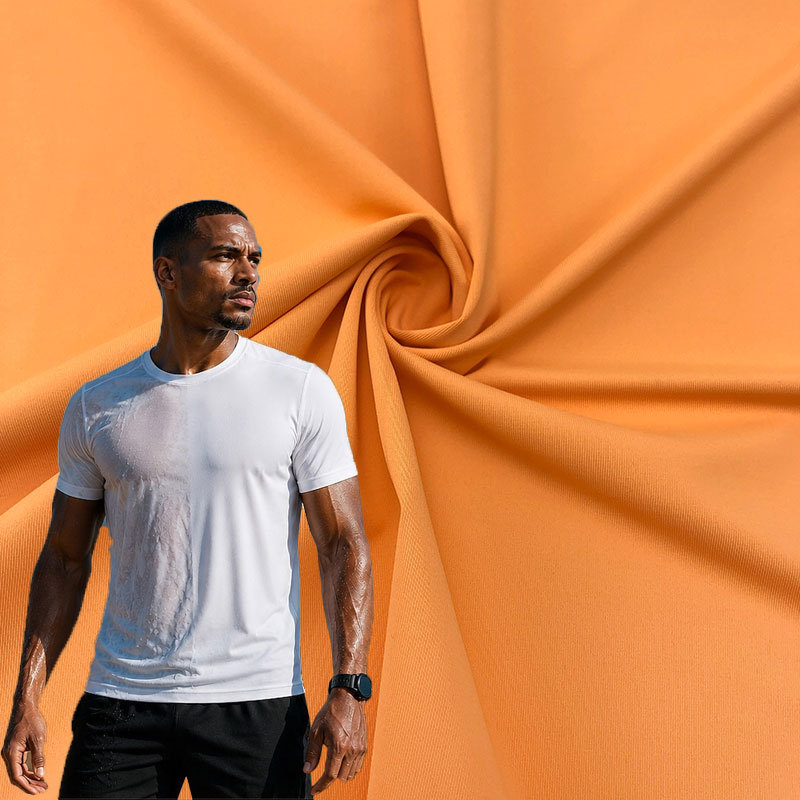
Category: Performance & Lifestyle Fabrics Brand: MontForge | Premium Men's Activewear Manufacturer Reading time: ~7 minutes
What Is Quick Dry Fabric?
Quick Dry Fabric is a performance textile engineered to accelerate the rate at which moisture — sweat, rain, or water from swimming or water sports — moves away from the skin surface and evaporates from the outer fabric face.
The term "quick dry" describes an outcome, not a single fabric type: it is achieved through a combination of fiber hydrophobicity, yarn filament count, knit structure, fabric weight, and in some constructions, surface moisture-wicking finish.
The practical performance standard for quick dry activewear is drying time from saturation to dry-to-touch: premium quick dry fabrics achieve this in 15–30 minutes under standard test conditions (ISO 17617 or AATCC 199).
Standard cotton reaches dry-to-touch in 90–120 minutes under the same conditions. This 3–6× difference in drying rate is the measurable gap that separates performance activewear from conventional sportswear in the consumer experience.
In short: Quick dry fabric is not a single material — it is a performance specification achieved when fiber type, yarn engineering, knit structure, and fabric weight are correctly combined. Understanding which combination produces which drying rate is the knowledge that allows a brand to make a substantiated quick dry claim rather than a marketing assertion.
Key Technical Specifications
Property | Specification |
|---|---|
Drying rate standard | ISO 17617 or AATCC 199 — time from saturation to dry-to-touch |
Target drying time (premium) | 15–30 minutes |
Target drying time (standard) | 30–60 minutes |
Primary fiber | 100% Polyester or Polyester-Spandex (most common); Nylon-Spandex (premium) |
Fabric weight range | 100–200 GSM (lighter fabrics dry faster at equivalent construction) |
Moisture regain (polyester) | ~0.4% — hydrophobic fiber, moisture transported by capillary action |
Moisture regain (nylon) | ~4% — slightly hydrophilic; absorbs small moisture volume at fiber level |
Moisture regain (cotton) | ~8% — highly hydrophilic; absorbs and retains moisture in fiber |
The Four Mechanisms Behind Quick Dry Performance
Quick dry performance is not a single property — it is the combined output of four physical mechanisms operating simultaneously in the fabric structure.
Mechanism 1: Fiber hydrophobicity Polyester fiber repels water at the molecular level — its moisture regain of 0.4% means it absorbs virtually no water into the fiber structure itself. Moisture on a polyester fabric surface exists entirely as a surface film on the fiber, not absorbed within it. This surface film is what capillary wicking can move — absorbed moisture within a fiber (as in cotton) is significantly harder to extract and evaporate. Hydrophobic fiber is the foundational requirement for quick dry performance.
Mechanism 2: Yarn filament count and capillary channel density Modern performance polyester yarns are produced as multifilament constructions — many individual filaments bundled into a single yarn. The gaps between filaments within the yarn bundle form capillary channels: pathways through which moisture moves by capillary action from the skin-contact face to the evaporation face. Higher filament counts (more filaments per yarn at finer individual diameters) produce more capillary channels per unit cross-section, increasing wicking velocity. A 150D/144f yarn (150 denier total, 144 individual filaments) wicks significantly faster than a 150D/48f yarn at identical GSM — the only difference is filament subdivision.
Mechanism 3: Knit structure and evaporation surface area Once moisture reaches the outer fabric face by capillary transport, it must evaporate. Evaporation rate is proportional to the surface area of moisture exposed to moving air. An open, textured knit structure — piqué, waffle, or open interlock — exposes more moisture-loaded fiber surface to airflow than a tight, smooth single jersey at equivalent weight. This is why textured-surface fabrics often have faster effective drying rates than smooth fabrics of equivalent fiber and weight: the surface geometry accelerates the final evaporation step.
Mechanism 4: Fabric weight (GSM) Lower GSM means less fiber mass per unit area — and therefore less total moisture volume that must be evaporated to reach dry-to-touch. A 120 GSM polyester knit holds less moisture at saturation than a 200 GSM construction of identical fiber type and knit structure, and therefore reaches dry-to-touch faster under identical conditions. This is the most frequently misused mechanism in quick dry fabric marketing — a lightweight fabric will always dry faster than a heavier fabric of the same fiber type, but this does not make it a "quick dry fabric" unless the drying rate meets the performance standard at the relevant use weight.
Quick Dry Fabric vs. Cotton: The Performance Gap Quantified
Property | Quick Dry Polyester Knit | Standard Cotton Jersey |
|---|---|---|
Moisture regain | ~0.4% | ~8% |
Saturation capacity (200 GSM, 1m²) | ~8g water absorbed in fiber | ~160g water absorbed in fiber |
Drying time (saturation to dry-to-touch) | 15–30 minutes | 90–120 minutes |
Weight gain during exercise | Minimal — moisture transported to surface | Significant — fiber absorbs and retains sweat |
Skin cling when wet | Minimal — hydrophobic surface releases moisture | High — saturated cotton adheres to skin |
Odour retention | Low (with anti-microbial treatment) | High — cotton fiber retains bacteria and odour compounds |
UPF rating (equivalent GSM) | UPF 25–50+ | UPF 5–15 |
This performance gap explains why cotton has been largely displaced from the performance activewear category — not for aesthetic reasons, but because its moisture management physics are incompatible with the performance requirements of sustained training use.
What Garments Is This Fabric Built For?
Quick dry performance is a relevant specification across virtually every men's activewear category — but the intensity of the quick dry requirement varies by use case, and fabric specification should be calibrated accordingly.
High-Intensity Training Tops and Base Layers
The category where quick dry performance is most critical. A training top in a high-intensity HIIT or CrossFit session absorbs sweat continuously across a 45–60 minute session — the fabric's ability to keep the skin surface dry determines whether the garment feels like a performance tool or a wet obstacle by the end of the session. Specification: 120–160 GSM, high-filament-count polyester (144f+) in single jersey or open interlock, with anti-microbial treatment.
Trail Running and Road Running Shorts
Running shorts are worn next to the skin at the thigh and seat — the highest-friction, highest-sweat zones in running. A quick dry inner liner in 80–110 GSM nylon-spandex warp-knit mesh or micro-mesh manages moisture at these zones while the outer shell provides structure and pocket function. The liner's drying rate is the performance parameter that determines whether the runner experiences chafing and discomfort in the final miles of a long run.
Water Sports and Swimming Training Shorts
For water sport applications — swimming, surfing, paddling — the quick dry requirement is at its most extreme: the fabric must transition from fully saturated (immersion) to dry-to-touch in under 30 minutes while the wearer is active. Specification: 100% polyester woven or knit at 100–150 GSM with a DWR finish on the outer face — DWR accelerates water removal from the fabric surface at the initial drying phase, reducing the effective drying time by 20–30%.
Travel and Lifestyle Activewear
For travel-oriented collections, quick dry performance is valued as a practical convenience feature — garments that can be hand-washed in a hotel sink and worn again within 30–60 minutes. This use case requires quick dry performance at lifestyle GSM weights (160–200 GSM) rather than pure athletic weights, and is better served by a nylon or polyester-modal blend that combines quick dry performance with a more refined, less technical hand feel.
Construction and Specification Notes
Quick dry claim substantiation Any garment marketed with a "quick dry" claim requires test documentation to ISO 17617 or AATCC 199 standard. The test measures time from saturation (fabric fully wetted to the point of no further absorption) to dry-to-touch (no visible moisture on the fabric surface). MontForge provides quick dry test reports on request for private label compliance and retail documentation purposes.
DWR interaction with quick dry performance DWR on the outer face of a quick dry fabric accelerates the initial drying phase by causing water to bead and roll off rather than wetting the fabric surface — reducing the volume of moisture the fabric must evaporate. However, DWR on a wicking fabric creates a directional tension: the outer face repels water while the capillary structure tries to pull moisture outward. For quick dry fabric with DWR, the correct specification is DWR on the outer face only — the inner face must remain untreated to allow capillary transport from skin to fabric.
Anti-microbial treatment interaction Quick dry fabrics transport moisture rapidly across the fabric surface, but the yarn surface remains moist during the drying phase — creating conditions for bacterial growth. Anti-microbial treatment (Blog 06) is strongly recommended as a co-specification with any quick dry fabric for training applications. The two treatments are compatible and complementary — anti-microbial treatment does not affect drying rate.
Sublimation compatibility Quick dry polyester fabrics are fully compatible with sublimation printing — the dye bonds at the fiber level without adding a surface layer that would impede moisture transport. Full-panel sublimation on a quick dry training top does not reduce the fabric's quick dry performance when correctly specified polyester-compatible sublimation inks are used.
Sourcing and Production Notes
Sample lead time: 7–12 days for standard polyester quick dry constructions. High-filament-count specialty yarns (288f+ constructions) extend to 12–18 days due to yarn sourcing lead time.
Bulk production timeline: 30–45 days. Quick dry fabric is one of the most widely available constructions in the activewear supply chain — lead time is primarily driven by fabric weight and finishing specification rather than fabric availability.
Quick dry testing: MontForge conducts drying rate testing to AATCC 199 on all quick dry fabric lots before production approval. Fabrics failing to reach dry-to-touch within 45 minutes under standard conditions are rejected for quick dry-specified production.
GRS-certified recycled options: GRS-certified recycled polyester is available across the full quick dry GSM range. High-filament-count rPET yarns (144f+) are available from MontForge's verified GRS supplier network — wicking performance is equivalent to virgin polyester at equivalent filament count and GSM.
Frequently Asked Questions
What makes a fabric quick dry?
Quick dry performance is produced by four combined mechanisms: fiber hydrophobicity (polyester's 0.4% moisture regain means water cannot absorb into the fiber), high filament count yarn (more capillary channels for faster moisture transport), open knit structure (more evaporation surface area), and low GSM (less moisture volume to evaporate). All four must be correctly specified — a high-filament-count yarn in a heavy, tight knit will not dry as fast as the same yarn at lighter weight and open construction.
What is the difference between moisture-wicking and quick dry fabric?
Moisture-wicking describes the fabric's ability to transport moisture from the skin-contact face to the outer evaporation face — it is one step of the drying process. Quick dry describes the complete process: wicking plus evaporation. A fabric can wick efficiently but dry slowly if its weight is high or its evaporation surface area is low. Quick dry is the more comprehensive specification — it subsumes wicking as a component property.
Is quick dry fabric the same as DWR-coated fabric?
No. Quick dry fabric manages moisture generated from the inside (sweat) by wicking it outward. DWR manages moisture from the outside (rain) by causing it to bead and roll off. The two properties address opposite moisture directions. DWR applied to the outer face of a quick dry fabric is a complementary upgrade — it accelerates initial drying by reducing the volume of external moisture the fabric must evaporate — but DWR alone does not produce quick dry performance.
Can quick dry fabrics be tested and certified?
Yes. The primary test standards are ISO 17617 (international) and AATCC 199 (US). Both measure time from saturation to dry-to-touch under controlled temperature and humidity conditions. MontForge provides test documentation to both standards for private label quick dry claims.
What GSM dries fastest?
Lower GSM dries faster at equivalent fiber type and construction — a 120 GSM polyester single jersey holds less moisture at saturation and therefore reaches dry-to-touch faster than a 180 GSM construction. For training tops where maximum quick dry performance is the brief, 120–150 GSM is the target weight range. For lifestyle and travel applications where hand feel and opacity are also requirements, 160–200 GSM with high-filament-count yarn maintains acceptable quick dry performance while meeting the aesthetic brief.
MontForge is a verified premium men's activewear manufacturer with over eight years of production experience serving independent European and global private labels.
Previous in the Performance & Lifestyle Fabrics series: Active Mesh Fabric: Breathability Zones, Weight Choices, and Ideal Applications
Next in the Performance & Lifestyle Fabrics series: Eco-Friendly & Recycled Fabric Guide: GRS-Certified Materials for Sustainable Private Labels