The Business of Custom Sportswear: Profit Margins, Pricing, and Manufacturing Costs
- Share
- publisher
- MontForge Team
- Issue Time
- Jul 18,2026
Summary
A founder's guide to the economics of custom sportswear: cost breakdowns, MOQ leverage, DTC vs wholesale margins, and the hidden costs that decide profitability.

Building a custom sportswear brand is as much a finance problem as a design one. Before you ever quote a price or launch a drop, you need to know exactly where the money goes — from the first meter of fabric to the duty paid at the border. Brands that understand their cost stack scale; brands that guess it bleed margin on every unit.
1. The Real Cost Stack: What You Actually Pay For
A garment’s price is not one number — it is a stack of engineered costs. According to the 2025 Global Sportswear Factory White Paper, a sportswear factory’s cost splits into three overlapping layers: direct materials (fabric and trims), direct labor and manufacturing (cut, make, finishing), and indirect development and operating costs (sampling, QC, certification, overhead). When both buyer and factory understand these variables, negotiations get faster and the price gets defensible. The biggest mistake new founders make is comparing suppliers on the unit FOB quote alone.
2. Anatomy of a Garment Cost Breakdown
Most premium sportswear items follow a remarkably consistent cost structure. Based on published manufacturer costing sheets (Halim Sports; Tech Pack Genius), the typical composition is:
- Fabric & direct materials: 40–60% of total cost — fabric alone is often 50–60% (Halim Sports). Fiber type, GSM, dyeing, and functional finishes drive this.
- Trims & accessories: 10–15% — labels, zippers (a YKK zipper carries a real price premium), threads, drawstrings.
- Cut & Make (CM) labor: 15–20% — pattern making, cutting, stitching, and factory overhead.
- Finishing & packing: 5–10% — folding, tagging, QC, compliant polybags or branded boxes.
- Freight & logistics: varies widely by incoterm (EXW, FOB, CIF, DDP).
As a sanity check, a premium cotton T-shirt can land at roughly $4.08 in total unit cost (fabric $1.80, cut & stitch $0.80, trims, print, packing, margin) and still retail for $25–$35 in the U.S. (Tech Pack Genius). Factory margin on top typically runs 10–30% depending on complexity.

3. How MOQ Drives Your Unit Price
Minimum Order Quantity is the single most misunderstood number in apparel. Every production run carries fixed setup costs — pattern grading, marker making, cutting-table setup, machine configuration — regardless of volume. PRP Apparel illustrates the math cleanly: $500 in setup spread across 100 units adds $5 per unit; spread across 500 units it drops to $1 per unit. The same garment can cost 20–40% less per unit at 500 pieces than at 100 (PRP Apparel; Clothly).
The effect compounds. Decho Real notes pattern making ($200–$500), sample development ($100–$300 each), and screen-print setup ($50–$150 per color) are largely fixed — on a 50-piece run that is ~$30/unit of pure setup; on a 500-piece run it falls to ~$3/unit. FIMY Apparel adds that crossing 300 units per style/color activates true economies of scale, and 5,000+ units plateaus at maximum efficiency. The lesson: negotiating MOQ is often more impactful than negotiating the unit price.
4. Fabric Cost vs. Construction Cost
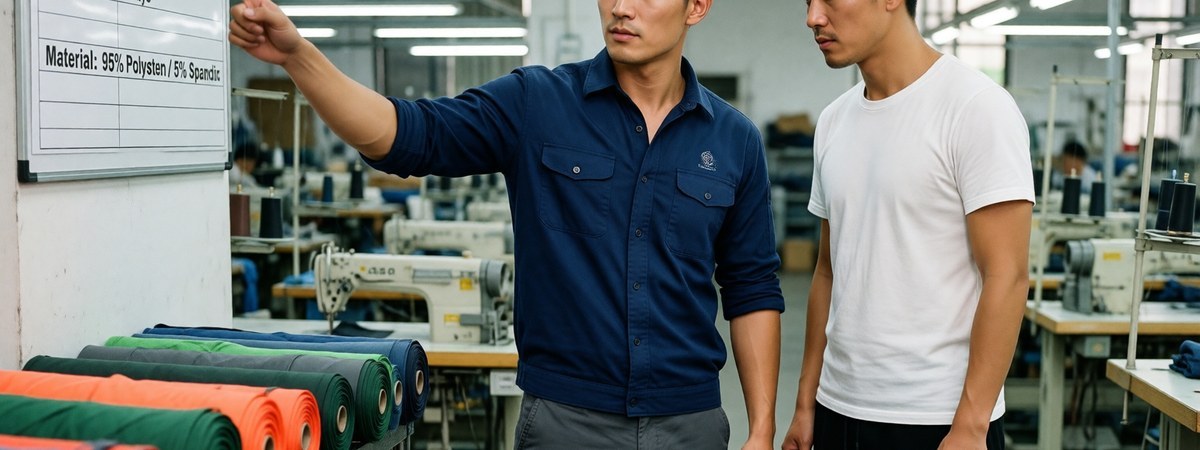
Within the cost stack, fabric is the lever you pull first. Heavier GSM means more grams per garment and a higher price; combed cotton costs more than carded; recycled or GRS-certified fibers typically add 10–30% (Ninghow Apparel) or 15–20% (Milky Fashions) versus conventional. Construction complexity is the second lever: every extra operation — a print, an embroidery, a contrast panel, a bonded seam — adds Standard Allowed Minutes (SAM) and cost. A flat screen print is cheap; multi-color placement prints and embroidery are not. A basic T-shirt has few processes and a low cost; a multi-layer composite jacket needs specialized equipment and costs significantly more.
Design for margin: choosing a standard, readily available fabric instead of a custom-knit textile can cut material cost by 20–30% with no visible quality loss (PRP Apparel).
Want a transparent cost sheet for your first collection? Send your inquiry →
5. Pricing Strategies for DTC Sportswear Brands
Once you know your landed cost, pricing is a model, not a guess. Most DTC sportswear brands apply a 100–150% markup from landed cost to retail — a mid-range golf polo at ~$30 landed typically prices at $60–$75 retail (Berun Clothes). The advantage of DTC is that you keep the margin you would otherwise hand to a distributor, which you can reinvest into customer acquisition. Anchor your price on the performance story (fabric tech, fit, durability) rather than racing competitors to the bottom on price alone. Build the model as: COGS + freight + duty + fulfillment + target margin, and pressure-test it against your customer acquisition cost.
6. Retail vs. Direct-to-Consumer Margin Analysis
The margin gap between wholesale and DTC is the reason so many brands are restructuring their channels. Skechers reported in the first half of 2025 a direct-to-consumer gross margin of ~66.5% versus ~42.8% for wholesale (reported via 东兴证券 / interface news). The mechanism is simple: a shoe with a ¥300 cost sold wholesale at ~¥500 yields a 40% brand margin; sold DTC at ¥1,000 it yields ~70%, capturing the 30–50% wholesale discount the brand used to forfeit (Anta DTC analysis, 2025).
On (On Running) posted 2024 revenue of CHF 2.32 billion, a 60.6% gross margin, and DTC revenue up 40.3% year over year (Ennews) — evidence that a DTC-heavy mix supports both growth and healthy margins. The caveat: DTC also pulls opex (rent, fulfillment, marketing) onto your P&L. Higher gross margin only becomes higher net profit if your per-dollar efficiency beats a distributor’s.
7. The Hidden Costs That Eat Margins
The FOB quote is only part of the story. Yunenx estimates factory pricing represents just 50–70% of total landed cost, breaking down roughly as: manufacturing 55–70%, packaging 3–8%, freight 8–20%, customs & duties 5–15%, testing & compliance 1–5%. For sportswear the duty line is brutal: importing synthetic activewear into the U.S. can carry duties up to 32% versus a few percent for cotton tees (FIMY Apparel; Fexwear).
Other surprises: sampling courier fees of $50–$150 per DHL shipment from Asia — three rounds easily hits $300–$450 (Berun Clothes); a 6-month operating runway of $20,000–$40,000 before steady sales; and rework. Fexwear models a 500-unit leggings run quoted at $14.00 FOB that becomes $21.30 landed in Los Angeles after $2.10 freight, $1.40 duty, and $0.80 rework. Budget development at 2–3% of first-order value and never skip the itemized cost sheet.
Get a full, itemized cost breakdown before you commit? Request a transparent quote →
8. Optimizing Your Cost Structure for Profitability
You do not cut quality to improve margin — you optimize at the source. Five proven levers:
- Consolidate fabric across styles. A mill’s Minimum Color Quantity can force 660 hoodies just to use custom-dyed fleece; designing three styles in one fabric satisfies the minimum and lowers yardage price across all of them (FIMY Apparel).
- Standardize trims. One zipper length, one thread color, one label across the collection unlocks volume discounts and simplifies procurement.
- Perfect your tech pack. Vague tech packs trigger 4–5 sampling rounds; a clean one caps you at 2–3. Samples cost 2–3x bulk price, so every avoided round protects margin.
- Build a long-term factory relationship. Factories price new customers conservatively; after two or three smooth orders you earn real leverage on price (PRP Apparel).
- Group colorways and sizes for bulk fabric buys and efficient cutting — less waste, lower labor per piece.

9. Frequently Asked Questions
What is the biggest cost in custom sportswear manufacturing?
Fabric is consistently the largest component, typically 50–60% of total garment cost. Fiber type, weight (GSM), dyeing, and functional finishes all move this number the most.
How much can MOQ lower my unit cost?
Moving from a 100-piece run to 500 pieces commonly cuts unit cost by 20–40%; scaling to full bulk production can drop it by up to 50% versus a startup run, because fixed setup costs spread across far more units.
Is DTC always more profitable than wholesale?
DTC delivers a much higher gross margin (often 60–66% vs ~40% wholesale), but it also absorbs fulfillment, marketing, and retail opex. Net profitability depends on whether your per-dollar efficiency beats a distributor’s.
What import duty should I budget for U.S. sportswear?
Synthetic activewear can face duties up to 32% into the U.S., while cotton garments are often far lower. Always verify the HS code for your exact fiber composition before forecasting margin.
10. Conclusion: Engineer the Cost Before You Engineer the Garment
The brands that win at custom sportswear treat cost as a design input, not an afterthought. Map the full stack, use MOQ as a pricing lever, lead with fabric and construction choices, model DTC margin honestly, and budget for the hidden costs — sampling, freight, duty, and working capital. Do that, and every unit you ship compounds into a brand that can actually scale.
Ready to build your custom sportswear line with a transparent sourcing partner? Start your inquiry →