The Complete Guide to Sportswear Fabric Sourcing: Quality, Cost, and Sustainability
- Share
- publisher
- MontForge Team
- Issue Time
- Jul 8,2026
Summary
Fabric is the highest-leverage sourcing decision in sportswear. This guide covers polyester vs nylon, spandex blends, recycled and organic options, testing standards (color fastness, pilling, shrinkage), manufacturer collaboration, and cost optimization, with 2025 market data and certifications.
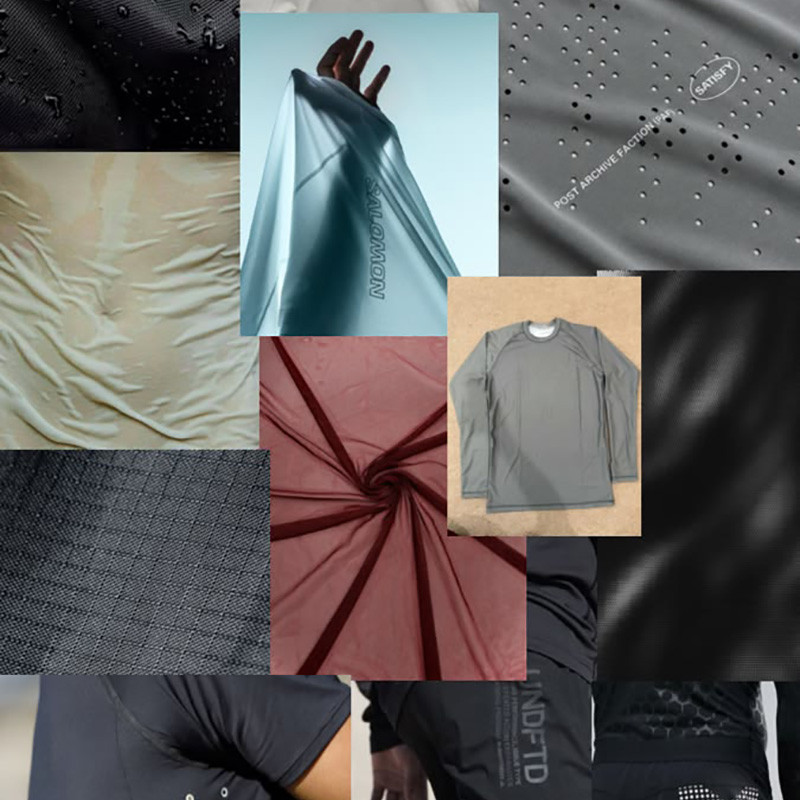
Fabric is the single highest-leverage decision in sportswear sourcing. It quietly sets your unit cost, your garment's performance on the gym floor, and how credible your sustainability story sounds to a buyer who reads care labels. Get the fabric wrong and no amount of marketing rescues the product; get it right and everything downstream — fit, durability, returns — becomes easier. This guide walks through how fabric choice drives cost and quality, how polyester, nylon, and spandex compare, where recycled and organic materials fit, the testing standards that separate premium from problematic, and how to work with a manufacturer to develop and cost-optimize your fabric platform.
1. How Fabric Choice Defines Product Cost and Quality
In sportswear, fabric is rarely a minor line item. Across manufacturers and cost consultants, fabric typically accounts for 45% to 70% of total garment cost — the single largest component, ahead of cutting, sewing, and trims. That means the composition, weight, and finish you choose at the sourcing stage predetermine most of your landed cost before a single stitch is sewn.
Weight, measured in grams per square meter (GSM), is the first lever. Industry norms run about 180–220 GSM for lightweight training wear, 220–280 GSM for standard leggings, and 280–350 GSM for high-compression garments. Heavier cloth uses more yarn and costs more, but going too heavy can hurt breathability. A vague brief like "premium fabric" leaves this unmanaged; a precise brief (composition, GSM, compression, color-fastness standard) is what keeps cost and performance aligned.
The fastest way to blow a budget is to let fabric choice drift during development. One wrong material can compromise compression, opacity, and moisture management — and surface as returns after launch. Define the fabric platform before the pattern, not after the first fitting.
2. Polyester vs. Nylon vs. Blends: Pros and Cons
Polyester (PET) and nylon (polyamide) are the two dominant synthetic fibers, and the choice between them shapes everything from hand-feel to price. Polyester is the world's most-produced fiber at roughly 52% of global output. It is hydrophobic, with moisture regain below 0.4% and a high melting point of 255–260°C. Those properties make it the stronger performer for moisture-wicking base layers and running shirts: it dries in 2–3 hours versus nylon's 3–4 hours, and it resists UV and chlorine far better, holding color through repeated wash and wear.
Nylon, by contrast, absorbs about 4.0–4.5% moisture and melts lower (215–220°C), but it is roughly 20% stronger than polyester and 30–40% more abrasion-resistant — showing 2–3× the cycle count to failure in Martindale testing. Its lower stiffness gives it a naturally softer, silkier hand and better elastic recovery, which is why premium yoga and compression wear lean nylon. The trade-off is cost: nylon typically runs 20–35% higher than polyester at the raw-material level.
Real FOB China pricing illustrates the gap: a polyester/spandex (85/15, 200 GSM) construction lands around $3.50–4.00 per meter, while a nylon/spandex (80/20, 210 GSM) construction runs $4.50–6.00 per meter. In practice, performance sportswear is almost never 100% of either fiber — it is a blend. A typical running shirt is about 88% polyester / 12% spandex, while premium leggings sit at 75–80% nylon / 20–25% spandex. The manufacturing rule of thumb: choose nylon/spandex (75/25 or 80/20) for yoga and everyday athleisure, and polyester/spandex (78/22 or 80/20) for HIIT, running, and printed styles.
Need help choosing the right base cloth for your line? Discuss your fabric strategy with our team →
3. The Role of Spandex in Performance Wear
Spandex — called elastane in Europe and sold under the Lycra® brand by Invista — is the stretch engine behind modern activewear. It is a polyurethane-based fiber that can stretch to 400–800% of its original length and recover more than 95% of its shape. It is never used alone; it is always blended in, usually as a core-spun yarn, in both warp and weft directions to deliver true 4-way stretch.
The percentage is the real design variable. At 2–5% spandex you get shape retention for casual knits; at 5–8% a light, comfortable stretch; at 10–15% a moderate athletic fit suited to training tops and shorts; at 15–20% the high stretch expected of yoga pants and leggings; and at 20–30% the firm compression of shapewear and recovery garments. Most high-performance activewear lands in the 10–20% spandex band.
Two cautions for sourcing. First, spandex is heat-sensitive: it begins to weaken above 160°C and degrades at typical ironing temperatures, which dictates care in heat-setting and sublimation. Second, pushing spandex past 18–20% reduces the polyester content available for dye uptake, which can dull sublimation print quality. Balance the stretch you need against the print and recovery you must keep.

4. Sustainable Fabric Sourcing: Recycled and Organic Options
Sustainability has moved from a marketing nicety to a sourcing requirement, and recycled synthetics lead the shift. Recycled polyester (rPET) is made mostly from post-consumer PET bottles — about 98% of its feedstock — and matches virgin polyester's performance while saving up to 59% of the energy used in virgin production. The market reflects that momentum: the global rPET market reached roughly $14.25–17.3 billion in 2025, and recycled polyester apparel is projected to grow at a ~8.5–9.3% CAGR through the early 2030s. In 2025, activewear and sportswear alone accounted for 41.3% of the recycled polyester apparel market (about USD 5.14 billion), the largest application segment.
For credibility, certifications matter. The Global Recycled Standard (GRS) and Recycled Claim Standard (RCS) verify recycled content and chain of custody, while OEKO-TEX Standard 100 confirms the finished fabric is safe from harmful substances. Major brands have committed hard: Adidas has targeted 100% recycled polyester across its products, and Puma aimed for 75% recycled polyester in apparel by 2025. Recycled nylon — such as ECONYL® regenerated from fishing nets and ocean waste — is growing but remains less established than rPET. Each tonne of recycled PET yields roughly 900–950 kg of yarn, and mechanical recycling still accounts for about 78% of rPET output, with chemical depolymerization emerging for higher purity.
Expect a 15–30% price premium on recycled fabrics versus virgin equivalents, driven by certification costs and lower supply volume. Brands that absorb it tend to win on positioning and long-term loyalty rather than on unit cost — a trade worth modeling before you commit.
5. Fabric Testing Requirements: Color Fastness, Pilling, and Shrinkage
"It looks fine" is not a quality standard. Premium sportswear is validated against recognized test methods, and the three most important families are color fastness, pilling, and dimensional stability.
Color fastness is graded on a 1–5 Grey Scale using multi-fiber adjacent fabric. Wash fastness follows AATCC 61 (Grade 4+) or ISO 105-C06; light fastness ISO 105-B02 (Grade 4); perspiration ISO 105-E04 / AATCC 15 (Grade 3–4); and rubbing or crocking AATCC 8 / ISO 105-X12 (Dry Grade 4, Wet Grade 3). These grades decide whether a deep color bleeds onto skin or equipment after a workout.
Pilling and abrasion are measured on the Martindale tester (ISO 12945-2 / ISO 12947): a Grade 3–4 minimum at 2,000 cycles for leggings and shorts, with premium high-friction styles held to Grade 4 at 5,000–7,000 rubs and abrasion resistance above 20,000 rubs before yarn breakage. Knits may also use the Random Tumble method (ASTM D3512). On the 1–5 scale, 5 means no pilling.
Shrinkage and dimensional stability follow AATCC 135 / ISO 6330: woven fabrics tolerate no more than 3% dimensional change and knits up to 5% shrinkage, with compression styles often tightened to ≤2%. Stretch recovery should exceed 95% within 60 seconds (ASTM D2594 / ISO 20932), and an opacity-under-tension check confirms "squat-proof" coverage at 20–30% elongation. Underpinning all of it are chemical-compliance frameworks — the AAFA Restricted Substance List, OEKO-TEX Standard 100, and ZDHC — covering formaldehyde, azo dyes, and heavy metals. Well-specified performance fabrics are built to endure 100,000+ wear cycles without meaningful deterioration.

6. Working With a Manufacturer on Fabric Development
The best fabric outcomes come from treating your manufacturer as a development partner, not just a cutter. Start with a precise brief: composition, GSM, compression level, color-fastness standard, and performance features — never the vague word "premium." A complete tech pack should capture measurement specs, stitching details, logo placements, fabric references, and label requirements so nothing is guessed at bulk stage.
Two gates protect you. Lab-dip approval verifies color matching before bulk dyeing — essential for pastels and neons where off-shades are expensive to fix later. And never skip sampling: one brand that waived the sample fee on compression shorts later found waistband rolling in bulk production, and the remake cost far exceeded the original sample. At the fabric level, a disciplined inspection cuts swatches from the start, middle, and end of every roll, checks GSM on a calibrated scale, and confirms wash shrinkage ≤3% in both directions, stretch recovery, color fastness, pilling, and width skew (≤3% per ISO 16322). A manufacturer's R&D team can also propose a standardized fabric platform that carries across multiple styles — the foundation of the cost strategy below.
Ready to develop a fabric platform for your collection? Start a fabric development project with our team →
7. Cost Optimization Strategies Without Sacrificing Quality
Because fabric drives 45–70% of cost, that is where optimization pays off most — but the goal is total cost, not the lowest per-meter quote.
Standardize a small core fabric library. Instead of sourcing eight fabrics across eight dye lots for one season, leading brands build multiple styles on 2–3 platforms (for example 75% nylon / 25% spandex, 220–280 GSM, 4-way stretch, UPF 50+ across leggings, bras, shorts, and jackets). The benefits compound: lower MOQ pressure, faster replenishment, better color consistency, and reduced testing cost.
Consolidate orders. Twelve thousand units placed in four production runs beat the same volume split into twelve small ones — better fabric pricing, lower setup, more efficient cutting layouts, and cheaper freight. Right-size your MOQ: at 50–100 pieces a factory charges a premium of roughly +40–60% for setup; 300–500 pieces is the efficient baseline; 1,000+ typically earns a 15–20% discount. Low MOQ reduces inventory risk but raises unit cost, so match the tier to your sales confidence.
Engineer for a target price. CAD pattern-making minimizes offcuts, and small efficiency gains of 10–20% add up across a run. Reduce SKU sprawl and stick to a few strong-selling colorways to avoid custom lab-dip fees. And resist the cheapest quote: an untested lower-priced cloth often hides higher warranty and rework costs later. Tell your manufacturer the price you must land at, and let them engineer the fabric and construction to hit it.
8. Frequently Asked Questions
Which is better, polyester or nylon, for sportswear?
Neither is universally "better." Polyester wins on moisture-wicking, quick-dry, UV and chlorine resistance, color retention, and cost — ideal for running, HIIT, and printed styles. Nylon wins on softness, abrasion resistance, strength, and recovery — ideal for yoga, compression, and premium athleisure. Most lines use both, matched to the activity.
How much spandex should activewear contain?
Most high-performance activewear uses 10–20% spandex: 10–15% for training and athletic fits, 15–20% for yoga and leggings, and 20–30% for compression and shapewear. Below 10% you lose meaningful stretch; above 20% you raise cost and can dull sublimation print quality.
Is recycled polyester as good as virgin polyester?
For performance, yes — rPET matches virgin polyester and cuts energy use by up to 59%. The caveats are a 15–30% price premium and the need for GRS or RCS certification to substantiate claims. It is the dominant sustainable choice for performance sportswear today.
What fabric tests matter most for quality?
Color fastness to washing and perspiration (AATCC/ISO, Grade 4+), pilling resistance (Martindale 2,000+ cycles, Grade 3–4), shrinkage (≤3% in both directions), and stretch recovery (≥95% within 60 seconds). Together they predict how the garment looks and fits after a season of real use.
How can I lower fabric cost without losing quality?
Standardize 2–3 core fabrics across collections, consolidate production orders, choose the right MOQ tier, use CAD cutting to reduce waste, and avoid over-engineering features. Optimize the system, not just the unit price.
9. Conclusion
Fabric sourcing is where sportswear success is won or lost. Choose the right polyester-or-nylon base for the activity, dial in the spandex for the fit, verify recycled content with real certifications, and validate everything against color-fastness, pilling, and shrinkage standards. Then optimize through standardization and consolidation rather than the cheapest quote. Do that, and cost, quality, and sustainability stop competing and start reinforcing each other.
Building your next collection? Send your fabric inquiry and we'll help you engineer it →