The Ultimate Guide to Manufacturing Custom Merch T-shirts for Influencers & Brands (Part 2): Manufacturing, Costs & Logistics | Montforge
- Share
- publisher
- Montforge Production Team
- Issue Time
- May 6,2026
Summary
Part 2 of our ultimate guide to influencer merch. Master manufacturing, cost optimization, and global logistics. Featuring the Montirex success story and expert insights from Montforge.

Introduction
Part 1 covers garment direction, artwork and decoration. This second guide focuses on moving an approved merch concept through quotation, production, delivery and fulfilment. The goal is a costed order with clear responsibilities and stock that can be received and dispatched accurately.
Finding a Reliable Merch T-shirt Manufacturer
Partnering with the right manufacturer is paramount to the success and quality of your custom merch T-shirt line.
Where to Find Custom Merch T-shirt Manufacturers
Use relevant product references, supplier directories, trade events and referrals to identify possible manufacturers. Compare a custom garment factory, an existing-blank decorator and a print-on-demand operator according to the service required. Location alone does not establish the cheapest or fastest route.
Evaluating Manufacturer Capabilities – The Complete Checklist
Evaluate relevant samples, the proposed production site, material sourcing, sample revisions and quality records. Verify documents by purpose and scope: OEKO-TEX STANDARD 100 covers identified articles, amfori BSCI is a social-audit framework, and laboratory providers issue reports for specific tests. Ask what evidence applies to this project.
Red Flags to Watch Out For
Be wary of manufacturers offering prices significantly lower than the market average, refusing to provide samples, or lacking proper quality documentation. Other red flags include poor communication, vague contracts, and a lack of transparency regarding their production process. Always conduct due diligence, request references, and verify their certifications.
Questions to Ask Before Signing
Before committing, ask critical questions: What are their MOQs? What is the typical lead time for samples and bulk orders? What are their payment terms? How do they handle quality control and returns? Do they offer design support or material sourcing? Discuss intellectual property protection and confidentiality agreements. Obtaining and evaluating samples is a crucial step to assess quality and fit before mass production.
Cost Calculation and Pricing Strategy
A robust understanding of costs and a strategic pricing model are vital for the profitability of your custom merch T-shirt business.
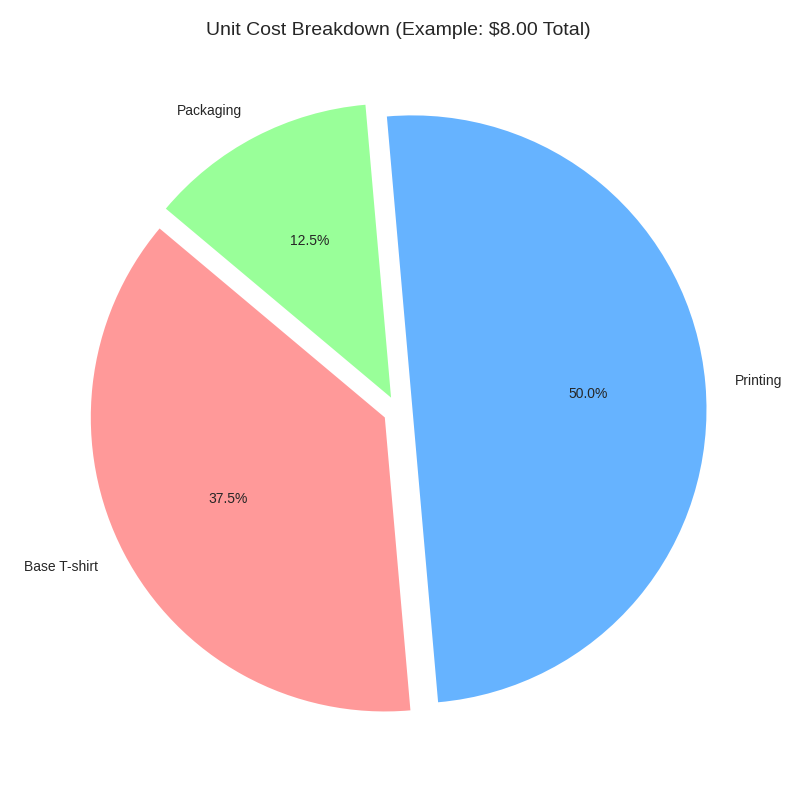
Understanding Your True Cost Per Unit
Build the unit calculation from defined inputs. As a hypothetical illustration, a garment at USD 3 plus decoration at USD 4 and packing at USD 1 totals USD 8 before any excluded costs. This is arithmetic, not a supplier quote. Development, rejects, delivery and fulfilment must still be assigned.
Minimum Order Quantity (MOQ) Strategy
MOQ significantly impacts your unit cost. Generally, higher MOQs lead to lower per-unit costs due to economies of scale. However, higher MOQs also mean a larger upfront investment and increased inventory risk. Assess your sales forecasts and budget to determine an appropriate MOQ. For smaller brands or new launches, consider manufacturers that offer lower MOQs or print-on-demand services, even if the unit cost is slightly higher. Montforge offers flexible MOQ solutions to accommodate various business scales.
Pricing Your Merch for Profit
Separate gross margin from contribution and net profit. If an illustrative selling price is USD 25 and the included product costs are USD 8, the difference is USD 17, or 68% of sales. That percentage excludes any costs not in the USD 8, such as selling fees, freight, fulfilment, returns, marketing and overhead; it is not a net-profit forecast.
Sample Order vs Bulk Production
Always start with a sample order. The purpose of a sample is to verify design accuracy, material quality, print fidelity, and overall fit before committing to bulk production. While samples incur additional costs, they mitigate the risk of costly errors in a large order. Ensure a smooth transition from sample approval to mass production by clearly communicating any adjustments needed and confirming all specifications with your manufacturer.
Logistics and Fulfillment Strategies
Efficient logistics and fulfillment are crucial for delivering your custom merch T-shirts to customers promptly and cost-effectively.
Shipping Options for Bulk Orders
Compare transport options for the actual origin, destination, packed dimensions and required receiving date. Ask which quote includes pickup, export handling, main carriage, clearance and final delivery. A transit estimate is not a guaranteed date for sellable stock to be received.
Fulfillment Solutions for Influencer Merch
Choose who will store stock, count inventory, pick orders, pack parcels and handle replacements. An in-house team and a 3PL have different fees and control requirements. Check the provider's receiving rules, store integration, service scope and charges before the factory packs the order.
Montirex Collaboration and a Costed Production Order
MontForge and Montirex have worked together successfully. That is relevant commercial context for a brand assessing a manufacturing partner. It should sit alongside clear evidence for the particular merch project being quoted: product requirements, sample results, order scope and fulfilment responsibilities.
For a new merch programme, document how an approved design becomes goods that can be received, counted and dispatched accurately. Keep the relationship history alongside the project's own material, sample and commercial evidence.
Build a cost sheet around the sales route
A direct-to-consumer parcel, a wholesale delivery and an event handout create different tasks after sewing. Decide who owns each task before comparing supplier prices.
| Cost or responsibility | Question to resolve |
|---|---|
| Garment and decoration | Which exact style, fabric and artwork does the quote cover? |
| Samples and setup | What is reusable on an unchanged reorder? |
| Labels and packing | Which files and components are included? |
| Delivery to stock | Where does the supplier's responsibility end? |
| Individual fulfilment | Who picks, packs and sends each customer order? |
| Corrections | Who handles shortages, mis-picks and replacements? |
A manufacturing quote and a dispatched-customer-order price should not be treated as equivalent offers.
Identify the approvals that protect the launch
Keep one approved garment, the artwork file, measurement chart, colour reference and packing instructions under the same revision. If a bulk material differs from the development sample, state what still needs approval.
Before announcing availability, identify the required dates for material confirmation, sample acceptance, production release, inspection and receiving. A factory completion date is not the same as the date sellable stock is available in the fulfilment system.
Make the first receiving report useful for the reorder
Record quantities by SKU, packing errors and quality issues against the production lot. Separate a manufacturing defect from a fulfilment mistake so the next order addresses the correct cause.
A useful production partnership maintains an identifiable product reference and a clear approval process. For the next order, record what repeats unchanged and what requires another review.
Use Part 1 to settle the audience, garment and artwork direction, then use the commercial and fulfilment records here to prepare the production order.
Frequently Asked Questions (FAQs)
Get quick answers to common questions about manufacturing custom merch T-shirts.
What is the typical MOQ for custom T-shirt manufacturing with Montforge?
Montforge offers flexible Minimum Order Quantity (MOQ) solutions to accommodate various business scales. While specific MOQs can vary based on design complexity, printing method, and fabric choice, we strive to support both emerging brands with lower MOQs and established brands requiring large-scale production. We recommend discussing your specific project needs with our sales team for a tailored solution.
How long does it take to produce custom merch T-shirts?
Agree a project schedule covering materials, decoration proof, garment sampling, bulk release, production, inspection and transport. Confirm the starting conditions and treatment of revisions or late artwork changes.
Can Montforge help with design and artwork preparation?
Yes, Montforge provides comprehensive support for design and artwork preparation. Our experienced team can assist with technical specifications, ensuring your designs are optimized for the chosen printing method. We can also guide you through color modes, resolution requirements, and file formats to achieve the best possible print results.
What quality control measures does Montforge have in place?
Request the quality plan for the actual garment: nominated material, decoration trial, sewing checks, accepted sample and final packing review. Ask for relevant dated documents with the correct entity and scope. A laboratory name or social-audit logo is not a guarantee that every product requirement has been met.
What are the payment terms for custom manufacturing orders?
Agree payment milestones, currency, inspection rights and treatment of nonconforming goods during quotation. Clarify what each payment releases and whether sampling or setup charges are credited; do not assume one arrangement applies to every order.
RFQ Focus: Manufacturing, Costs & Global Logistics
When initiating an RFQ (Request for Quotation) for the manufacturing and operational phase of your merch line, please provide the following information:
•Order Volume & Frequency: Estimated initial order quantity and projected reorder frequency.
•Target Unit Cost & Retail Price: Your desired cost per unit and target selling price to ensure profitability.
• Required evidence: identify relevant material claims, article certificates, audit information and product tests separately.
•Shipping Destination & Timeline: Specific delivery locations (e.g., US, EU) and desired delivery dates.
•Fulfillment Model: Whether you plan to use in-house fulfillment or require 3PL integration.
•Scaling Potential: Discuss your long-term growth plans and how we can support increased production volumes.