Why More Sportswear Brands Are Moving Manufacturing from Vietnam to China in 2026
- Share
- Issue Time
- Jul 12,2026
Summary
In 2026 the apparel supply chain is rebalancing: US tariff relief, vertical integration, small-batch speed, and certified quality are pulling technical sportswear volume back to Chinese factories for US-facing brands. Here is the nuanced verdict.

For most of the past decade, the apparel playbook was simple: move production out of China to diversify risk. Vietnam became the poster child of that shift. But 2026 is rewriting the script. Not because China "won" and Vietnam "lost" — the reality is more interesting — but because a specific cluster of forces is pulling technical sportswear volume back toward Chinese factories for the brands that sell into the United States and demand speed, consistency, and co-development. This article explains the dynamics, the tradeoffs, and how to decide what is right for your line.
1. The 2026 Supply-Chain Reset: Why the Pendulum Is Swinging Back
The headline trade numbers still favor Southeast Asia. According to 2025 TexPro data, Vietnam's apparel exports to the United States reached $17.02 billion, a 20.81% market share, while China's direct exports to the US fell to $11.95 billion from $18.40 billion a year earlier. On the surface, that looks like a clean handover.
It is not. What is actually happening in 2026 is a three-tier restructuring of the supply chain. China is strategically retreating from the "final stitch" — the labor-intensive, tariff-sensitive assembly — while tightening its grip on the high-value upstream segments: yarns, fabrics, specialized trims, and technical components. China still produces roughly 55% of the world's raw synthetic fibers and more than 30% of global textile output, and Vietnam still imports 60–80% of its textile raw materials from China. Brands that "de-risked" by shifting finished-goods assembly to Vietnam often discovered they had only increased their indirect exposure to Chinese industry. The lesson of 2026: diversifying the country of origin is not the same as diversifying the supply chain.
2. China's Structural Edge: Infrastructure and a Vertically Integrated Chain
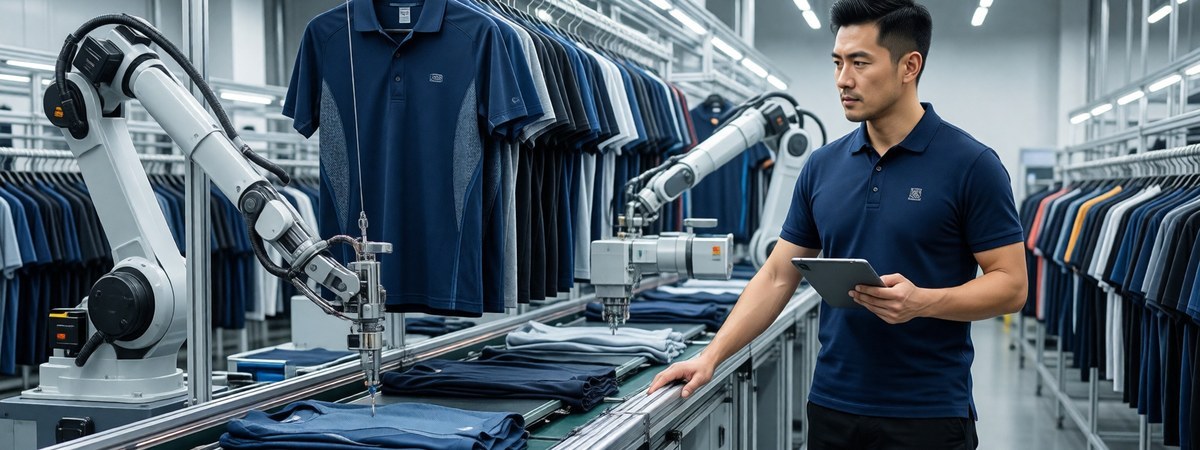
The single biggest advantage China retains is vertical integration. In a single domestic system you can find spinning, weaving, dyeing, finishing, and cut-and-sew — the entire fiber-to-finished-garment journey. Vietnam, by contrast, imports most of its fabric and must add customs steps, lead time, and cost volatility on top of every order.
This depth shows up in two practical ways. First, material sourcing speed: a custom dye, an unusual trim, or a recycled fabric can be located, tested, and delivered in days rather than weeks. Second, waste control: modern digital pattern nesting in Chinese factories reduces fabric waste by about 12% versus 2023 standards. For a margin-sensitive brand, that is real money returned to the bottom line.
Evaluating a vertically integrated partner? Send your material specs and we will map a sourcing plan →
3. Speed to Market: The "Small-Batch, Fast-Reaction" Advantage
China's coastal hubs have standardized a model called 小单快反 — "small-batch, fast-reaction." Brands can launch a test collection at 100–200 pieces per style, read real sales data, and scale the winners within weeks. That agility is precisely what a trend-driven sportswear brand needs in 2026.
Lead times tell the story. Reorder cadences built around Chinese suppliers typically run 30–45 days, versus 60–90 days for the equivalent Vietnam cycle once fabric sourcing and pattern transfer are included. When a drop is time-sensitive — a seasonal colorway, a collaboration, a viral moment — those 30 days are the difference between riding the wave and missing it.

4. Quality Consistency: Engineering vs. Execution
Vietnam has closed much of the technical gap and produces excellent performance wear. But the structural difference remains: China leads at product engineering, Vietnam at production execution. For complex activewear — bonded seams, high-tension elastane, compression zones, laser perforation — the engineering discipline matters.
The measurable proof is sample-to-bulk accuracy. Top-tier Chinese OEM/ODM factories report 95–99% design-to-bulk replication, achieved through digital pattern grading and MES-tracked production data. When your approved sample and your thousandth unit are the same garment, returns drop and brand trust compounds. That consistency is why leading factories pair a dedicated in-house pattern team with four-level quality inspection at every stage, from cutting to packing.
5. Certification and Compliance: Meeting the New Global Bar
Compliance is no longer a checkbox; it is a market-access requirement. Reputable Chinese sportswear manufacturers carry a stack of certifications — BSCI, WRAP, OEKO-TEX Standard 100, GRS (Global Recycled Standard), Disney FAMA, and the ISO 9001 / 14001 / 45001 family — and run AQL 2.5 inspections as standard. For EU-bound goods, the approaching Digital Product Passport (DPP) rules make this traceability non-negotiable.
A transparent certification portfolio also de-risks your own brand. When a factory can hand you test data (AATCC colorfastness, shrinkage, tensile) and full visibility of production flow, you are not hoping your supplier is compliant — you are proving it to your customers and to regulators.

6. Communication and Co-Development: Designing With, Not Just For
The old critique of Chinese manufacturing — "great at making, weak at collaborating" — has eroded. Coastal factories now run bilingual, English-speaking project teams, real-time ERP tracking, and video design reviews. Many operate in-house CAD and 3D pattern development, trend forecasting, and cloud-based tech packs, so your tech pack is a living document rather than a fax.
The strategic upgrade is moving from vendor to co-developer. A factory that contributes fabric R&D, fit engineering, and sustainable-material options becomes an extension of your brand — shortening the path from concept to bulk and improving the result. For a premium sportswear label, that partnership is worth more than a few cents of unit savings.
Want a partner who designs with you? Start a co-development conversation →
7. Total Landed Cost: Why Cheap Labor Isn't Cheap Anymore
The Vietnam-vs-China wage gap is real but narrowing. Vietnamese manufacturing wages sit around $250–350 per month versus $500–700 in coastal China — but Vietnam's national minimum wage rose 7.2% on 1 January 2026, and a proposed cut from a 48-hour to a 40-hour workweek would push overtime costs sharply higher. The labor arbitrage that fueled the first relocation wave is quietly compressing.
More important is the tariff swing. For US-bound apparel, Vietnam now faces a reciprocal tariff of roughly 46% layered on existing 15–16% duties — an effective rate near 61–62% — while comprehensive US tariffs on Chinese apparel are expected to fall below 20% (down from as high as 55%). That is a 35+ percentage-point swing in China's favor for the American market. The European equation flips: under EVFTA, Vietnam enters at 0% while China faces about 12% MFN duty, so EU-focused brands still favor Vietnam.
| Factor (US-bound order) | Vietnam 2026 | China 2026 |
|---|---|---|
| Effective tariff | ~61–62% | <20% |
| Typical lead time | 60–90 days | 30–45 days |
| Small-batch (100–200 pc) test | Limited | Standard (小单快反) |
| Upstream material control | Imports 60–80% from China | Vertically integrated |
The takeaway is simple: compare total landed cost — unit price plus tariff, freight, and compliance — not factory-gate price. For US-facing technical sportswear, the tariff swing alone can erase Vietnam's labor savings many times over.
8. How MontForge Represents the New Standard
The factories winning the 2026 rebalancing share a profile — and it is the one MontForge is built around. A digitally managed OEM/ODM operation with MES + ERP production tracking, 12–15 day sampling and 25–30 day bulk turnarounds, an in-house fabric library, full certification, and genuine small-batch fast-reaction capability. The differentiator is not being the cheapest; it is being the most predictable, transparent, and fast to iterate.
For brands selling into the US, that combination — tariff-competitive pricing, vertically integrated speed, certified quality, and co-development — is exactly why the pendulum is swinging back. For EU-focused brands, a China-plus-Vietnam mix remains the smart play. The winning strategy in 2026 is a layered portfolio, not a single-country bet.
9. Frequently Asked Questions
Is China actually regaining apparel share from Vietnam in 2026?
For finished-goods volume to the US, not yet at the aggregate level — Vietnam still leads US imports. But for specific segments (technical sportswear, US-bound orders, small-batch fast-reaction), Chinese factories are winning renewed inquiries because tariffs flipped and China's speed and engineering edge reasserted itself.
Does this mean brands should leave Vietnam entirely?
No. A "China plus one" or layered portfolio is the resilient structure. Vietnam retains a clear edge for EU-bound goods under EVFTA (0% duty) and for very large-volume basic runs. The smart move is matching each product line to the best country for its market and attributes.
What is total landed cost and why does it matter?
It is the full cost to get a unit to your door: factory price + tariff + freight + compliance and testing. Because the 2026 US tariff gap (~35+ points) dwarfs the wage gap, comparing factory-gate prices alone is misleading for US-facing brands.
How do I verify a Chinese factory's certifications?
Request the actual certificates (BSCI, OEKO-TEX, GRS, ISO) and recent AQL 2.5 inspection reports, and ask for MES/ERP production visibility. Reputable partners provide these proactively rather than on demand.
Conclusion
The story of 2026 is not "China versus Vietnam" — it is a supply chain maturing into a three-tier system where each node plays to its strength. China's vertically integrated chain, small-batch fast-reaction speed, engineering-led quality, certification depth, and co-development capability are pulling technical sportswear volume back for US-facing brands. Vietnam keeps its edge for EU-bound and high-volume basics. The brands that win are the ones that treat sourcing as a portfolio: allocate by market, by product complexity, and by speed requirement — and partner with manufacturers who are transparent, certified, and fast to iterate.
Ready to build a resilient, China-strong sourcing strategy? Send your inquiry and talk to our team →