How to Brief Jogger Tech Packs (Fabric, Fit, Waistband)
- Share
- publisher
- MontForge Sourcing Team
- Issue Time
- Sep 27,2026
Summary
A jogger tech pack checklist: must-have specs, cuff and waistband options, artwork guidelines, the 7-15 day sampling loop, and bulk-readiness checks.
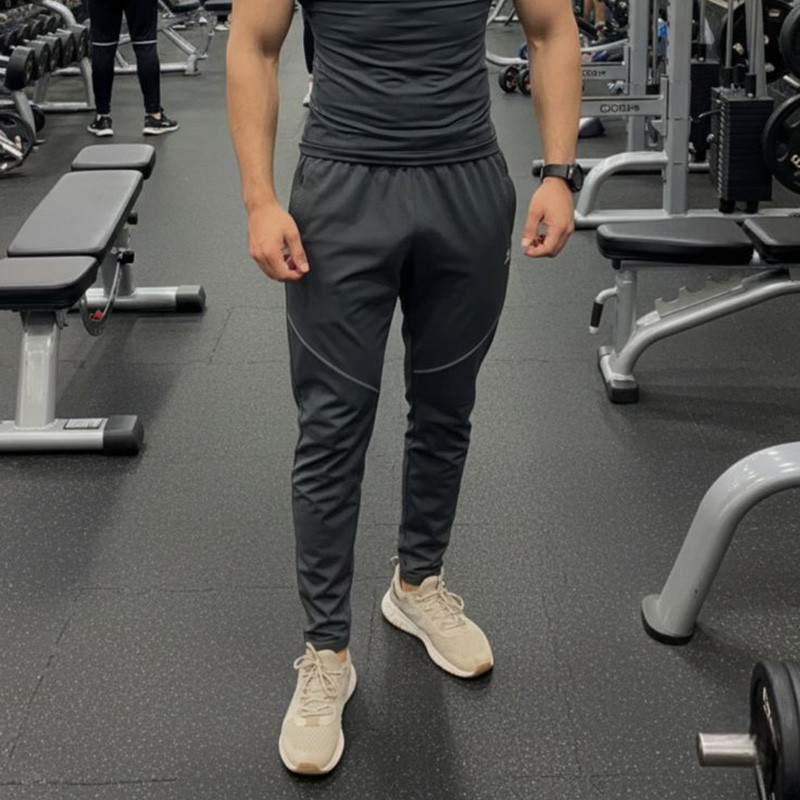
A jogger looks simple on a line sheet, but a single pair carries a long list of decisions at once: fabric weight and composition, waistband construction, ankle cuff, pockets, drawcord, trims, branding and grading. A good tech pack turns that list into an unambiguous blueprint so the first sample comes back with minimal revisions — which is the whole point. This guide covers the must-have specs, cuff and waistband options, artwork guidelines, the sampling loop, and how to get to bulk readiness. If the fit-versus-fabric decision is still open, start with our guide to jogger silhouettes.
The Must-Have Specs in Any Jogger Tech Pack
A complete tech pack has five sections, and skipping any one of them is how sampling rounds multiply. First, the technical flat — a clean front-and-back line drawing, not a fashion illustration — that anchors every other page. Second, the points of measure (POM): for every size, list the waist relaxed and extended, hip, front rise, back rise, inseam, outseam, thigh, knee, leg opening and total length, and state explicitly whether each is a half or full measurement, since "chest 54 cm" without that qualifier is a classic mis-spec. Third, the bill of materials: fibre content, GSM, finish, plus every trim — elastic width, drawcord diameter and length, aglet type, rib construction, thread colour and labels. Fourth, colourways with a Pantone TCX reference, never a screen colour. Fifth, construction: stitch types, seam finishes, hem and rib, topstitching, and branding placement with dimensions. Add a tolerance range (typically plus or minus half a centimetre on key points) so the factory knows what is acceptable, and always attach a reference garment or swatch when you can.
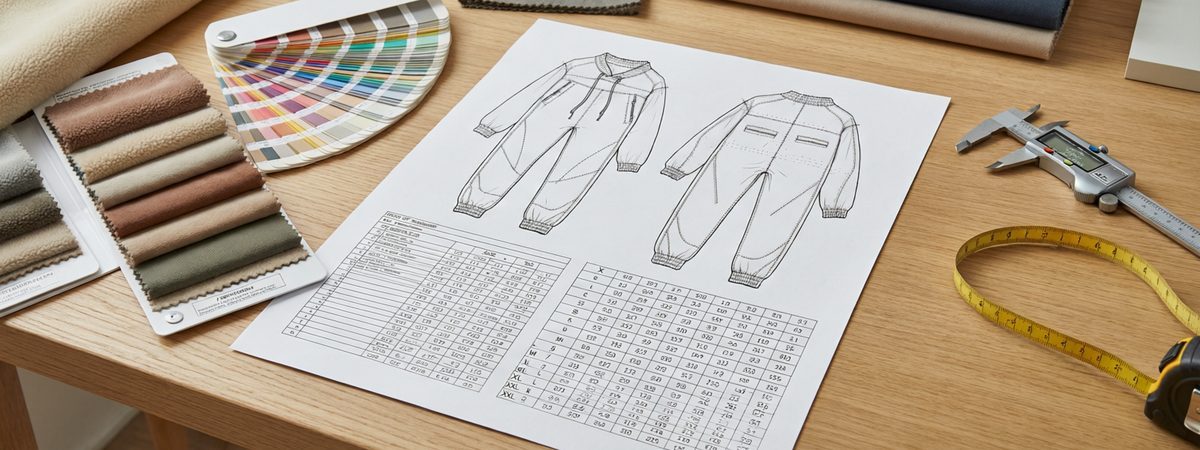
Fabric and GSM: Write It, Don't Imply It
"Cotton fabric" is not a specification. For joggers, the working weight bands are: French terry at 260–380 GSM for premium retail and athleisure, brushed fleece at 280–380 GSM for a soft, everyday hand, and lightweight jersey at 180–220 GSM for summer and gym use. State the composition precisely (for example 80% cotton / 20% recycled polyester at 285 GSM), the finish (pre-shrunk, enzyme-washed, brushed interior), and the supplier reference if you have one. The fabric choice drives the waistband and cuff decisions that follow, and it is worth resolving hand-feel against weight early — see our brushed fleece vs French terry breakdown before locking GSM, because a 300 GSM terry and a 300 GSM fleece feel nothing alike.
Waistband Options: Elastic, Drawcord and Rib
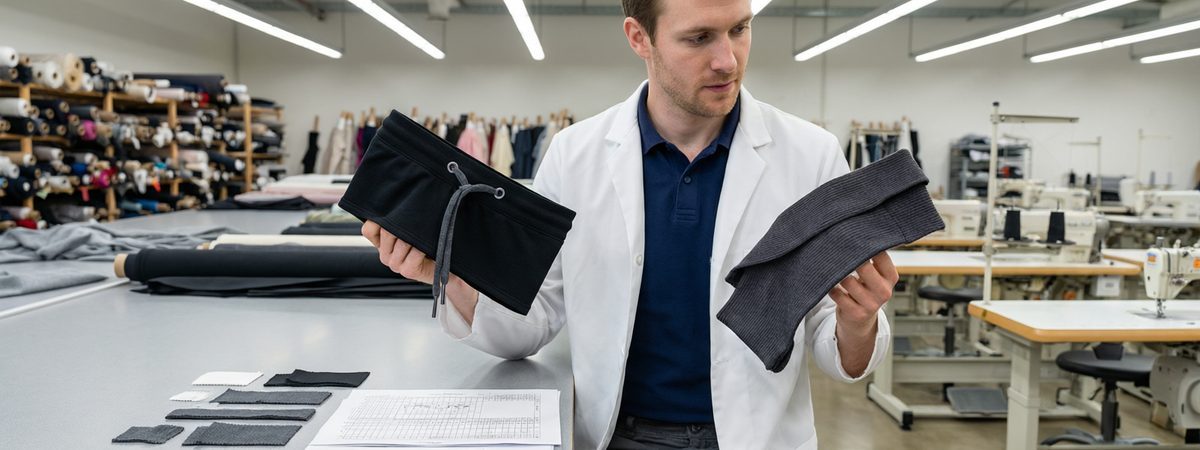
The waistband is a small engineered system, not an afterthought. Three constructions dominate. A full elastic waistband (3–4.5 cm wide, no drawcord) is the cleanest and suits institutional and workwear programmes. An elastic plus drawstring waistband (2.5–4 cm elastic, with the cord either tunnelled inside or run through metal eyelets) is the retail jogger standard. A rib-knit waistband (a separate 1×1 or 2×2 rib panel, 5–10 cm wide) drops the elastic entirely and is the premium, fashion-led option — but the rib must be yarn-matched or colour-matched to the body and produced in the same dye lot, or the waist reads a shade off the rest of the pant. For the drawcord itself, specify all four parameters: diameter (5–8 mm is retail standard, 8–10 mm for premium), length (130–160 cm), tip (metal or plastic aglet for retail, heat-sealed for budget), and colour. Note the safety rule: on children's sizing, a waist drawcord longer than 75 cm is prohibited under EN 14682, so specify a full elastic waist or a short sub-75 cm cord.
Cuff Options: What Makes It a Jogger
The hem decides whether the garment reads as a jogger or a sweatpant. A ribbed cuff — a separate rib-knit band at the ankle, typically 8–15 cm wide — creates the gathered, tapered jogger silhouette and is the defining detail of the category; it must be yarn-matched to the body and dyed in the same lot so it does not fade to a different tone. An open hem (no cuff, the body fabric simply hemmed) is the classic straight-leg sweatpant look and suits a relaxed or streetwear fit. A banded hem (a separate woven or knit band that is not rib) is a fashion construction for lifestyle retail. The cuff specification is where a weak rib reveals itself after a season — a rib without elastane or at too loose a gauge goes wavy and slack, so specify the elastane content and gauge explicitly rather than writing "ribbed ankle."
Artwork Guidelines: Print, Embroidery and Placement
For branding, specify the application method, exact dimensions, position and colour reference every time — "put the logo on the thigh" is not enough. On a jogger, common placements are the left thigh, the leg, the waistband, the back pocket or a tonal mark above the cuff. Embroidery and heat transfer both hold up better on a soft fleece or terry face than a screen print, and a small embroidered mark at the hip reads more premium than a full-leg graphic. Send artwork as high-resolution vector files (AI, EPS or PDF) at 300 DPI minimum, and for embroidery provide the digitized file plus stitch count and thread colours. Approve a strike-off or stitch-out sample before bulk so the brand red on the label is the same brand red on the leg.
Pockets and Construction Detail
Pockets are easy to overlook and expensive to fix. Side-seam pockets — a pocket bag sewn into the existing seam — are the most common and sit inside the standard price, with a bag depth of 22–28 cm and either self-fabric or a lighter lining. Welted or bound pockets add structure and cost and suit premium lifestyle programmes; cargo pockets need dimensions, a flap-closure type and bartack reinforcement at the stress points. On the construction side, state the stitch types (single needle, double needle, cover stitch), the seam finish (overlock, flat-fell, bound), and the topstitching location and stitch count. Every one of these is a line in the BOM, and every missing line is a question that delays the sample.
The Sampling Loop: From Sketch to Approval
The sampling loop is where the tech pack earns its keep. A qualified project typically runs a pre-production sample in 7–15 days, and a well-specified pack should get to an approved fit in one or two rounds. The loop is: send the pack and any reference garment, receive the first sample, fit it on a live model against the POM and grade rule, photograph and annotate the changes, and return a revised spec. Approve the waistband on the actual sample in the intended fabric, because a brushed fleece, a cotton terry and a lightweight jersey all carry an elastic differently. Record the finished waist relaxed, the extension, and the recovery after repeated stretch — ASTM D4964 is the reference for elastic tension and elongation — so the bulk run repeats what you approved rather than what the factory remembered.
Bulk Readiness: The Final Checklist
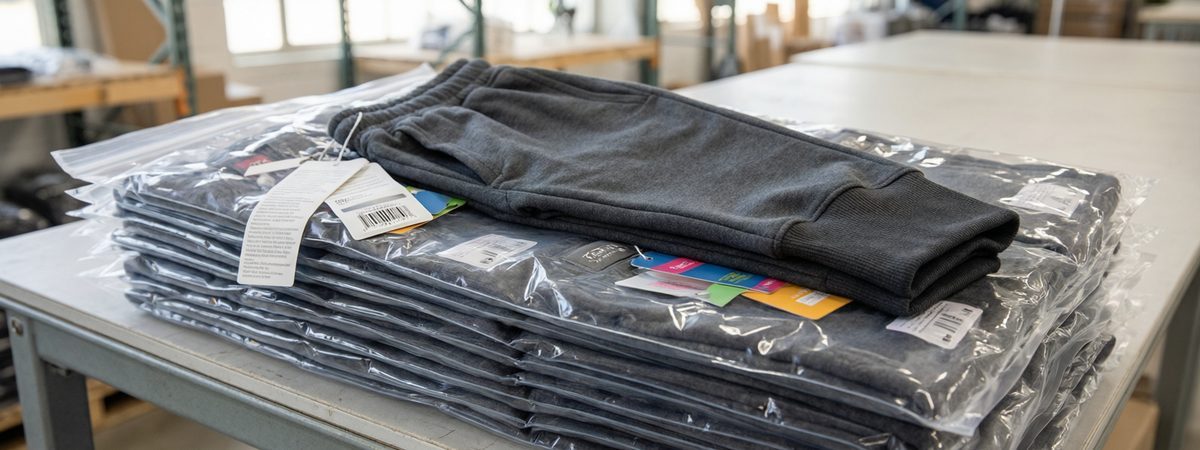
Before you green-light bulk, confirm every open item is closed. The size chart and grade rule are locked and match the approved sample. The fabric, rib and drawcord are confirmed from the same dye lot so the cuff and waistband match the body. Artwork is strike-off approved, and label placement — care label, size label and brand label — is written into the pack with exact positions. Packaging is specified (fold method, individual polybag, hang tag, barcode and carton), because "standard packaging" is not a thing. Finally, set the bulk inspection standard — an AQL 2.5 general inspection level is the common retail baseline — so the production run is checked against the same spec you approved, not against a memory of it.
Frequently Asked Questions
What are the must-have sections in a jogger tech pack?
A technical flat, points of measure with a size chart and tolerances, a bill of materials (fabric plus every trim), colourways with Pantone references, and construction details including stitching, hem, rib and branding placement.
What is the difference between a full elastic and a rib-knit waistband?
A full elastic waistband uses an encased elastic band (3–4.5 cm) with no drawcord. A rib-knit waistband is a separate 1×1 or 2×2 rib panel (5–10 cm) that stretches on its own, but it must be yarn-matched and dyed in the same lot as the body.
How long should a jogger drawcord be?
130–160 cm for adult retail, with a 5–8 mm diameter and metal or plastic aglets. On children's sizing, a waist drawcord longer than 75 cm is prohibited under EN 14682, so use a full elastic waist or a short cord.
What GSM should I specify for joggers?
French terry at 260–380 GSM and brushed fleece at 280–380 GSM are the premium retail bands; lightweight jersey at 180–220 GSM suits summer and gym joggers. State composition, GSM and finish explicitly.
How many sampling rounds should I expect?
With a complete tech pack, a pre-production sample typically takes 7–15 days and should reach an approved fit in one or two rounds. A vague pack multiplies the rounds and the delay.
Brief it once, sample it right. Explore MontForge custom joggers or send us your tech pack — fabric, waistband, cuff and branding specified to the millimetre, sampled in 7–15 days and delivered bulk-ready.